
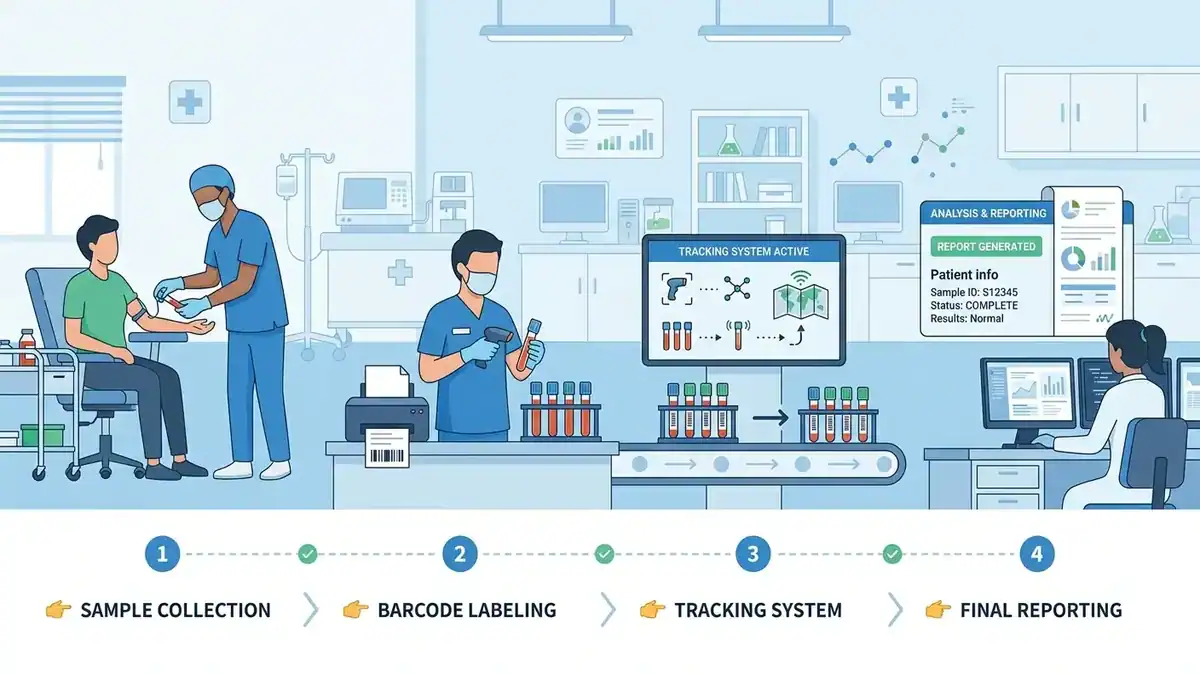
In the lab, sample tracking, management, and documentation are critical factors in result accuracy. Throughout a sample’s life cycle-from collection to reporting-gaps in the sample tracking process can result in mistakes, compliance failures, or delays in getting results.
Most laboratories currently experience problems with lab sample tracking, which often involves manual data input and workflow bottlenecks that do not allow for transparency in sample status even with advances in digital technologies. In this blog, we will discuss various ways to enhance lab sample traceability, minimize lab errors, and develop more consistent lab workflows by implementing new LIMS sample tracking solutions.
Why Lab Sample Tracking Matters
The laboratory errors that occur are not arbitrary. The clinical studies report that up to 70% of laboratory errors happen during the pre-analytical process-which can include a variety of activities, from the point of sample collection to tracking samples and their labels-and automation can improve error rates by 20-50% through integrated digital tracking and reminders. From this, improving lab sample tracking cannot be an afterthought-accuracy and turnaround time depend on the lab sample tracking process.
Some common pre-analytical errors such as mislabeling, incorrect sample collection, and improper handling or transport continue to impact laboratory accuracy and efficiency.
How to Optimize Lab Sample Tracking (Practical Measures)
1. LIMS Sample Tracking System Implementation:
A LIMS sample tracking system streamlines sample tracking, lab workflows and documentation at one location. With advanced LIMS such as LIMSXL you get not just basic sample tracking but also:
- Sample tracking embedded within the lab workflow
- Customizable lab workflows as per requirements of diverse lab setups
- NABL-compliant work list management
- Controlled authorization workflows
This leads to total management and transparency of lab samples.
2. Barcode Sample Tracking System:
Barcode systems have reduced identification error in manual processing. You get:
- Sample uniquely identified
- Faster turnaround of the samples
- Better sample traceability
With a LIMS system, scanning a barcode updates the data automatically at the relevant field.
3. Robust Lab Documentation System:
Digital lab documentation helps in compliance with the standards. A robust system needs:
- Audit Trails
- Time-stamped logs
- Sample-wise links and attached documents
A lab documentation system integrated with the LIMS provides better efficiency and compliance.
4. Automation in the Lab workflow:
Automation at lab procedures can significantly minimize dependency on manual work:
- Automatic work list generation
- Auto-formatted reports
- System-based reminders and notifications
- Patient updates via WhatsApp, etc.
This greatly decreases lab burden and speed-up turn around.
5. Standardize Sample Handling Processes
Define clear workflows for:
- Sample collection
- Labeling
- Testing
- Reporting
Consistency improves reliability and reduces errors.
6. Enable Real-Time Tracking and Alerts
A good system provides:
- Live sample status
- Location tracking
- Delay alerts
This ensures proactive management instead of reactive fixes.
What makes a good lab sample tracking system?
Not every system produces results. Below are some parameters for a good system.
- End-to-end sample traceability
- Customizable workflows
- Lab instrumentation integration
- Real-time dashboards
- Audit trail and compliance tracking
Solutions such as Mechsoft’s LIMSXL deployed in a variety of labs and hospitals illustrate how automation of the lab workflow coupled with a disciplined system of documentation could drastically increase efficiency and throughput.
At over:
– 19M+ samples processed
– 6M+ reports produced
– 6M+ patients analyzed
The scalability has been tested and proven in a real-world environment, not on paper.
The Role of LIMS in Mitigating Critical Errors
A well-installed LIMS sample tracking system can:
– Decrease manual errors
– Shorten turnaround time
– Maintain regulatory compliance
– Enhance visibility
And supports:
– Two-level authorization (technician + physician)
– Secure workflows
– Centralized reporting
These are the cornerstones of improved accuracy and accountability in the lab.
The future of lab sample tracking
Laboratories of the future will also adopt:
- AI-enabled data validation
- Cloud-based LIMS systems
- Predictive workflow analytics
- Remote diagnostics integration
Systems such as LIMSXL with a 30-year history of laboratory information systems will be well-positioned to adapt and support these changing requirements.
In conclusion
Increasing lab sample tracking capabilities goes beyond mere efficiency. The stakes are in reliability, compliance, and accuracy. Laboratories with a combination of integrated:
– LIMS sample tracking
– Lab workflow automation
– Disciplined laboratory documentation
will have greater capacity for growth, be less error-prone, and be better able to achieve consistent, reproducible results. A laboratory stuck in a world of manual processes and fragmented systems will only have theoretical risk; operational risk is already a factor.
Frequently Asked Questions (FAQs)
Q.1 What is lab sample tracking?
Ans. Lab sample tracking is the process of monitoring samples throughout their lifecycle, from collection to reporting, ensuring accuracy and traceability.
Q.2 Why is sample traceability important in laboratories?
Ans. Sample traceability ensures that every step is recorded, helping prevent errors, maintain compliance, and improve reliability.
Q.3 How does LIMS improve lab sample management?
Ans. A LIMS sample tracking system automates workflows, centralizes data, and improves visibility, reducing manual errors in pathology labs and improving efficiency.
Q.4 What are the benefits of automation in laboratory workflows?
Ans. Automation reduces manual workload, improves turnaround time, minimizes errors, and ensures consistent documentation.
Q.5 How does LIMSXL help in lab sample tracking?
Ans. LIMSXL provides:
- End-to-end sample tracking
- Barcode integration
- Workflow automation
- Secure authorization
- Real-time reporting
This improves both efficiency and accuracy.


